

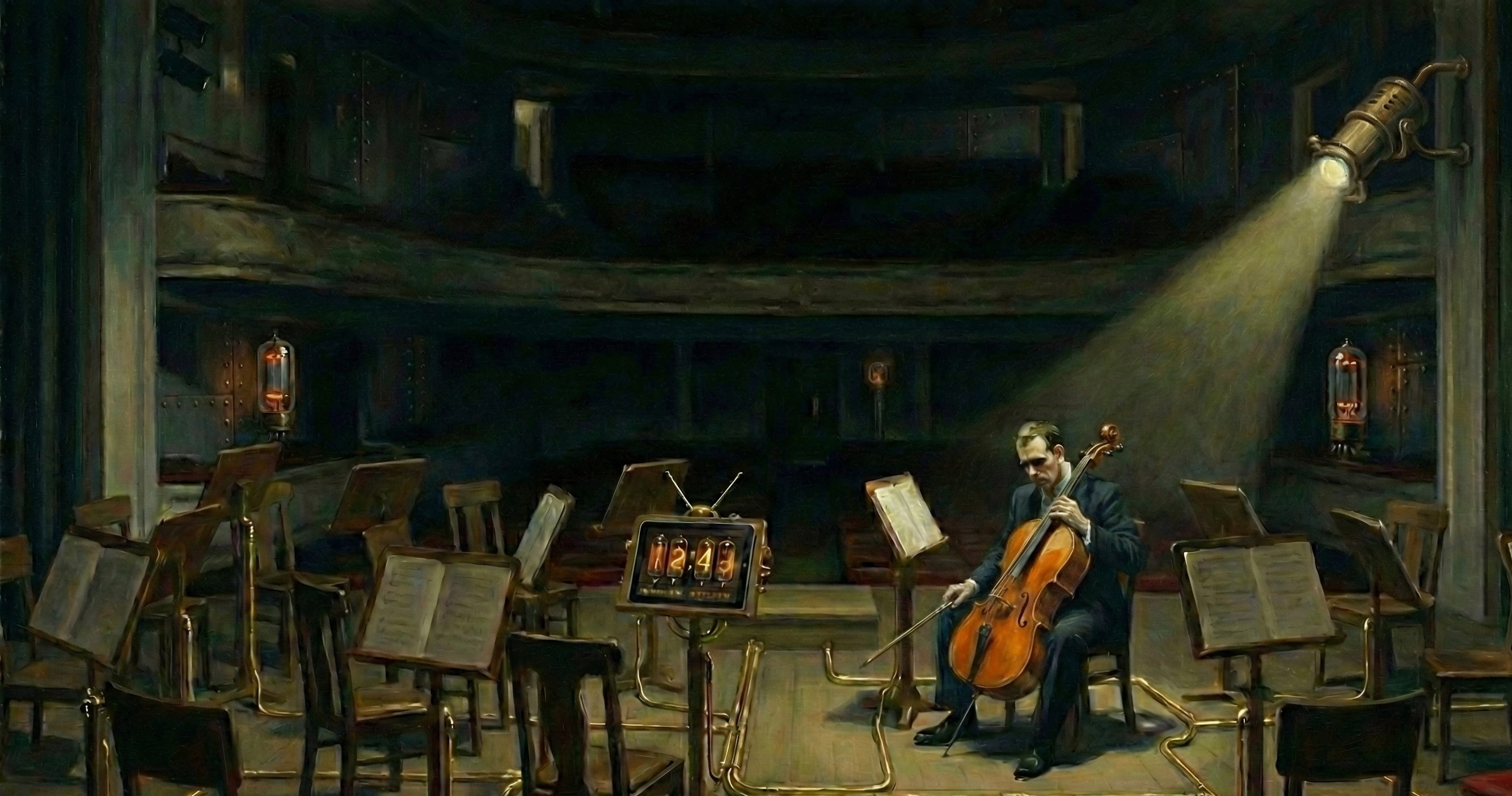
We’re saving you a whole lot of trouble, the administration says to future Americans. The country has overextended itself; our boys have been killed in Kandahar while thugs in Caracas sip margaritas! We’re giving you a world where these globalist cabalist institutions are finally in the dirt. You’ll stride across continents. You’re welcome.
This solution, a return to Hemispheric priorities, intrinsically cedes influence abroad to America’s adversaries. That’s by design - who needs Taiwan when you can have Tijuana? The Administration ties their new global order to the age of European imperialism, when a divvied-up world was balanced between select sovereigns, a time when men in wigs, tights and ornate tunics made the House of Commons look like a Chappell Roan concert. America’s new “might makes right” worldview, however, fundamentally misunderstands the historical spheres-of-influence system it seeks to replicate. Ignorant of that misunderstanding, the administration dismantles the current system rather than reforming it. Future Americans are left with less global influence than ever.
The years of global war and continental slaughter wrought by the French Revolution had traumatized the traditionalist monarchies of Europe. Now gathered in Vienna, the imperial representatives set about constructing a new world order atop the rubble of Napoleon’s Continental System. Austrian Foreign Minister Klemens von Metternich presented the final plan:
Each imperial power would balance the others, preserving stability through diplomacy, mutual restraint, and fear of a coalition of the others. Foreign policy would be conducted through “spheres-of-influence”, geographic chunks where one great power held privileged political, economic, or strategic control. Rival powers agreed not to interfere in each other’s spheres. Oh - and let’s not forget to partition Poland for the fourth time. Just for the fun of it. The “Concert of Europe” was established.
The system yielded a period of relative restraint amongst the powers which lasted for nearly a century. Yes, “relative restraint” is not total restraint; the Franco-Prussian War, the Crimean War, and endless abuses in the conquered reaches of empires still saturated the age in violence. However, from a global stability perspective, things were mostly calm. While each power conducted its own section of the concert, the sum of music was harmonic.
Marco Rubio must consider himself a modern Metternich – following the defeat of the perceived revolutionary globalist forces which tried to conquer the world (though Marco’s revolutionaries erected regulatory frameworks in Brussels rather than guillotines in Paris), he now sits with his extra-large Sharpie and atlas. The extent of each sphere is still murky. What’s clear is the United States gets the Western Hemisphere. Russia seems to get the former Soviet States. The extent of China’s sphere remains to be seen. Ironically, European states face the same fate they visited upon the non-great powers in the 19th century – choose a sphere now or have one chosen for you. The conservative-leaning publication National Interest put the re-ordering concisely: “Other states should also adjust to new geopolitical realities... [The U.S. is] staking its claim to the Western Hemisphere while ceding (or conditioning) primacy elsewhere to other powers.”
The Trump administration assumes influence is maintained by the strength of a sphere’s dominant power. Stephen Miller, the White House Deputy Chief of Staff, articulated this understanding in the context of America’s claim to Greenland: “We live in a world ... that is governed by strength, that is governed by force, that is governed by power. These are the iron laws of the world since the beginning of time.”
This understanding, while well suited for a Bond villain monologue, articulates a comically surface-level view of how spheres of influence historically maintained stability. The 19th and early 20th century spheres of influence system was stable because of the supranational similarities binding together European aristocrats – not because of muscle flexing isolationism. Historian Paul W. Schroeder, a preeminent scholar on the Concert of Europe, notes: “The European system worked because it rested on an international aristocratic society… diplomacy was the profession of a small, socially homogeneous elite bound by common culture, values, and personal ties.”
Spheres of influence worked because they sat below an integrated, pan-European aristocratic class conducting the Concert of Europe. These conductors shared general cultural norms, social status, and often bloodlines. Imperial European states themselves shared fundamental objectives: suppressing revolution, maintaining balance-of-power mechanics, and the norm of “consultation” among great powers.
States certainly continued competing, but friction between spheres was kept cool due to high-level alignment of interests by those in charge. While the British and Russians of the 19th and early 20th century may have disagreed with the balance of power in central Asia, they both agreed that history itself was European, and everything beyond it merely geography. King George V of Britain and Tsar Nicholas II of Russia were first cousins, after all. The Concert of Europe had an implicit agreement among powers: regardless of the individual notes, the score would be in High Classical style.
Putin, Xi Jinping, and Trump have irreconcilable tastes in music. There are no intrinsic bonds connecting the conductors of these states, no agreed upon arc of history to guide their interactions. In fact, each of these powers has a national myth totally incompatible with the others:
America is a republic which tells itself it’s a nation of self-made individuals who push into new frontiers, break rules that feel illegitimate, and turn risk into opportunity. Russia is an autocracy which tells itself it endures surrounded by threats, hardened by suffering, and made legitimate through sacrifice in defense of the motherland. China is a communist state which tells itself it is an ancient civilizational state reclaiming its rightful centrality after humiliation, with unity and order as the precondition for national rejuvenation. These are fundamental, irreconcilable national characteristics which limit the similarities between great powers necessary for a spheres of influence system to remain stable.
America, China, and Russia are structurally incompatible. None treats ‘balance of power’ as an end in itself as European Imperials did, only as a temporary constraint. Each wants maximum freedom of action, and each suspects the others’ rules are just camouflage for domination. They never shared a common aristocratic class bantering over a Christmas goose in Vienna.
There were, however, post-war global institutions, built by the United States, that created a shared framework which tilted towards the U.S. The United Nations, NATO, and the World Trade Organization, fostered a shared framework of rules, diplomacy, and economic interdependence that mirrored the aristocratic harmony of old. They allowed incompatible powers to negotiate without immediate resort to force. Critically, they also gave the United States an overt advantage in geopolitics; the U.S. built the system to reflect American values. Yet, in their confusion, the current administration has dismantled or undermined these institutions, ironically considering them antithetical to a sphere-of-influence global system. They were actually the only things which might have made it work.
Uninhibited globalism is bad. Europe failing to fairly shoulder NATO’s burden is bad. Bringing China into the WTO as a full member was bad. This is not a defense of global institutions which have encumbered ordinary Americans with international burdens. But we need to be able to have two thoughts simultaneously: Americans are allowed to want to prioritize Americans and Americans need to support certain international institutions because they allow for engagement with the world. We can stop subsidizing Europe’s capability shortfalls without imploding NATO. We can renegotiate trade deals with China without dismantling the WTO. We can think Davos itself is stupid and irrelevant and wasteful without torching Geneva.
America built the international system because it gave America an advantage. Over decades, that advantage was corroded by individuals who believed its function was not to perpetuate American hegemony, but to build a world where which assumed countries have equally noble intentions. That was an obvious mistake. But dismantling the system at large is an even bigger mistake. Regardless of the strategic errors made by successive State Departments, the chessboard is still made in America. Boomers and millennials who have reaped the benefits of this system while undermining its true purpose have decided it is better to throw it in the woodchipper than work to reform it for future Americans’ benefit.
We must recognize that we are building a new global system while demolishing the institutions that made that system historically function. These institutions serve as the contemporary analogue to the pan-European aristocratic bonds that once harmonized rival powers in a fragile but functional concert.
Despite the shared cultural, familial, and socio-economic bonds, the European powers still eventually blew the whistle and charged over the trench. Thirty years of near-constant mechanized warfare would follow. Today, those whose vain machismo envisions a striding colossus across their sphere have, in their ignorance, dismantled the very mechanisms which prevent their neighbor’s colossus from taking an extra step. Metternich plugs his ears – the music of the forming Concert of Powers will devolve into a simple bass rhythm of hypersonic missiles.